Scavenging and Its Types of Scavenging Systems in Two-Stroke Marine Engines
Scavenging is an important process in two-stroke marine diesel engines. It helps remove exhaust gases from the cylinder and replace them with fresh air for the next combustion cycle.
Unlike four-stroke engines, two-stroke engines do not have separate intake and exhaust strokes. The timing of a two-stroke engine cycle is therefore much shorter than that of a four-stroke engine.
What Is Scavenging?
n a two-stroke marine engine, scavenging is the process of supplying fresh air to the cylinder while removing the burned exhaust gases.
The effectiveness of this process has a direct influence on the engine’s operating performance. Proper air movement through the cylinder helps prepare the combustion space for the next cycle.
Types of Scavenging Systems
There are three main types of scavenging systems:
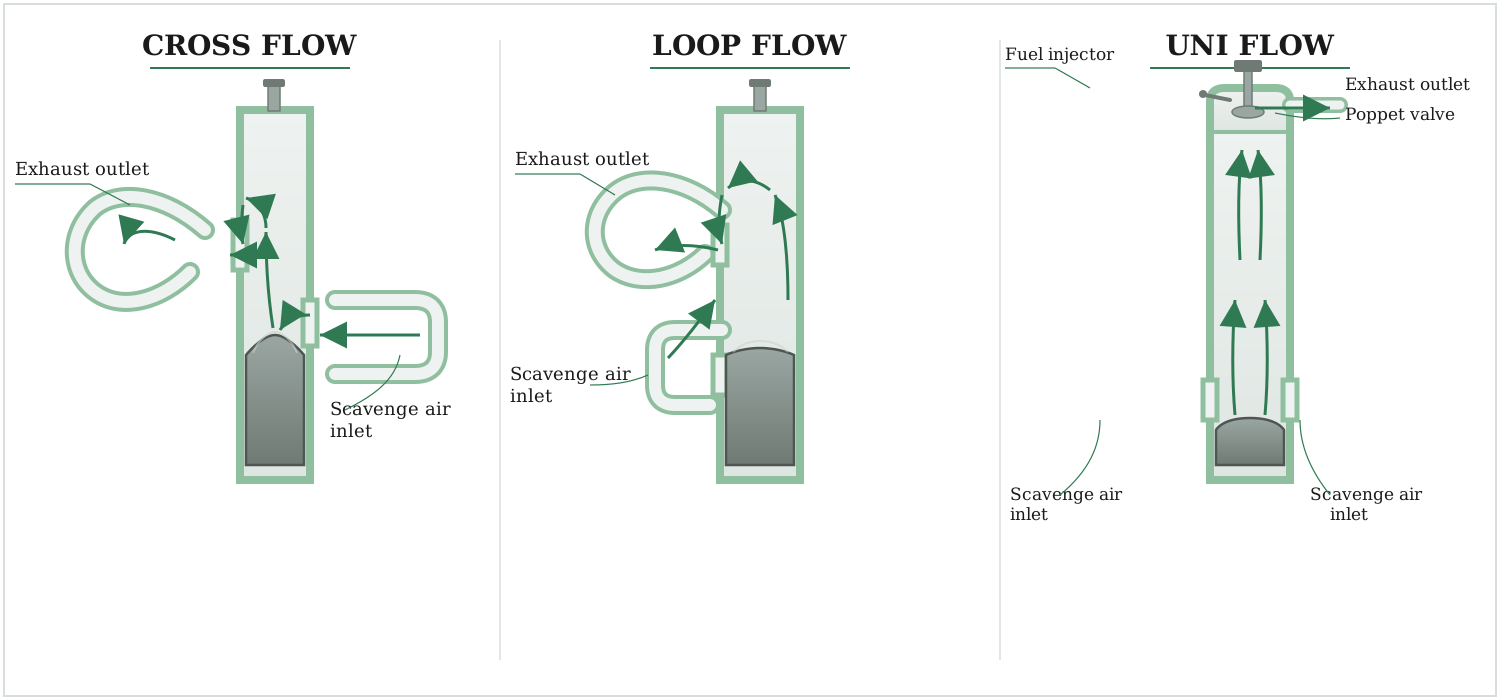
Cross-Flow Scavenging:
- The exhaust and air inlet ports are arranged around the boundaries of the lower end of the cylinder liner.
- Inlet and exhaust ports are located opposite to each other.
Loop flow scavenging:
- The exhaust and air inlet ports are arranged around the boundary of lower end of the cylinder liner.
- In loop scavenging engines, the exhaust ports are placed on top of the inlet ports on same side.
- Incoming air passes transversely over the piston is forced to leave through exhaust ports.
Uni-flow scavenging:
- Uni flow scavenging engines are also known as poppet valve engines, air and exhaust gases passing through the cylinder do not change the direction.
- Fresh air enters from the inlet port which are situated at the lower end and exhaust gases comes out from the top through exhaust port.
- In the exhaust port the poppet valve is placed which controls the exhaust outlet, mechanically or hydraulically from a camshaft.
Modern engines are equipped with uniflow scavenging system which has :
- higher specific output.
- improved fuel efficiency.
- higher scavenging efficiency.
Why Is Scavenging Important in Marine Engines?
Efficient scavenging is essential for the operation of modern two-stroke marine diesel engines. The scavenging system must effectively exchange the exhaust gases and fresh air within the cylinder to support the next combustion cycle.
For shipowners, operators and marine engineers, understanding the scavenging arrangement can also be useful when inspecting engine performance and carrying out maintenance.
Cross-Flow vs Loop-Flow vs Uni-Flow
| Scavenging Type | Port Arrangement / Air Movement |
|---|---|
| Cross-Flow | Inlet and exhaust ports are positioned opposite each other. |
| Loop-Flow | Exhaust ports are positioned above the inlet ports on the same side; air passes over the piston. |
| Uni-Flow | Air moves through the cylinder predominantly in one direction, providing high scavenging efficiency. |
Conclusion
Scavenging is a fundamental part of the operation of two-stroke marine diesel engines. The three principal scavenging arrangements are cross-flow, loop-flow and uni-flow.
Understanding the differences between these systems can help marine engineers and technical teams better understand two-stroke engine operation, maintenance and performance.
Sindhu Marine FZE supplies marine engine and turbocharger spare parts for the shipping and power-generation industries. For marine spare parts requirements, technical enquiries or quotation requests, contact our team.