
A marine turbocharger operates in a harsh environment where exhaust gases, carbon deposits, soot, oil mist, and salt particles gradually reduce its efficiency. Regular turbocharger washing is one of the most effective preventive maintenance practices to restore performance, reduce fuel consumption, and extend the service life of both the turbocharger and the marine diesel engine.
At Sindhu Marine, we supply genuine and OEM turbocharger spare parts for leading brands including ABB/Accelleron, MAN, Mitsubishi MET, KBB, Napier, IHI, and MTU. We also support shipowners, managers, and repair companies with technical guidance and high-quality replacement components.
Why is Turbocharger Washing Important?
Routine turbocharger washing helps maintain maximum airflow and combustion efficiency by removing accumulated contaminants.
Key Benefits
- Improves engine performance and turbocharger efficiency
- Reduces fuel consumption
- Restores compressor airflow
- Removes carbon and soot deposits
- Prevents turbocharger imbalance
- Extends bearing and rotor life
- Reduces maintenance costs
- Increases engine reliability
- Minimizes unexpected downtime
Regular cleaning also helps maintain the designed pressure ratio and ensures the engine receives sufficient combustion air.
1. Compressor Side Wet Washing
Compressor side wet washing is the most common maintenance procedure performed onboard ships.
2.When is Compressor Washing Performed?
The procedure is normally carried out while the engine is operating at approximately 80% load or higher, allowing the turbocharger to rotate at high speed. depending on engine condition and fuel quality.
Compressor Washing Procedure
Step 1 – Prepare the Cleaning Equipment
Depending on the turbocharger design, use either:
- Water washing container
- Water washing gun
Only fresh water should be used unless the manufacturer specifies otherwise.
Step 2 – Fill the Cleaning Device
Fill the container or washing gun with the manufacturer’s recommended quantity of fresh water.
Step 3 – Inject Water
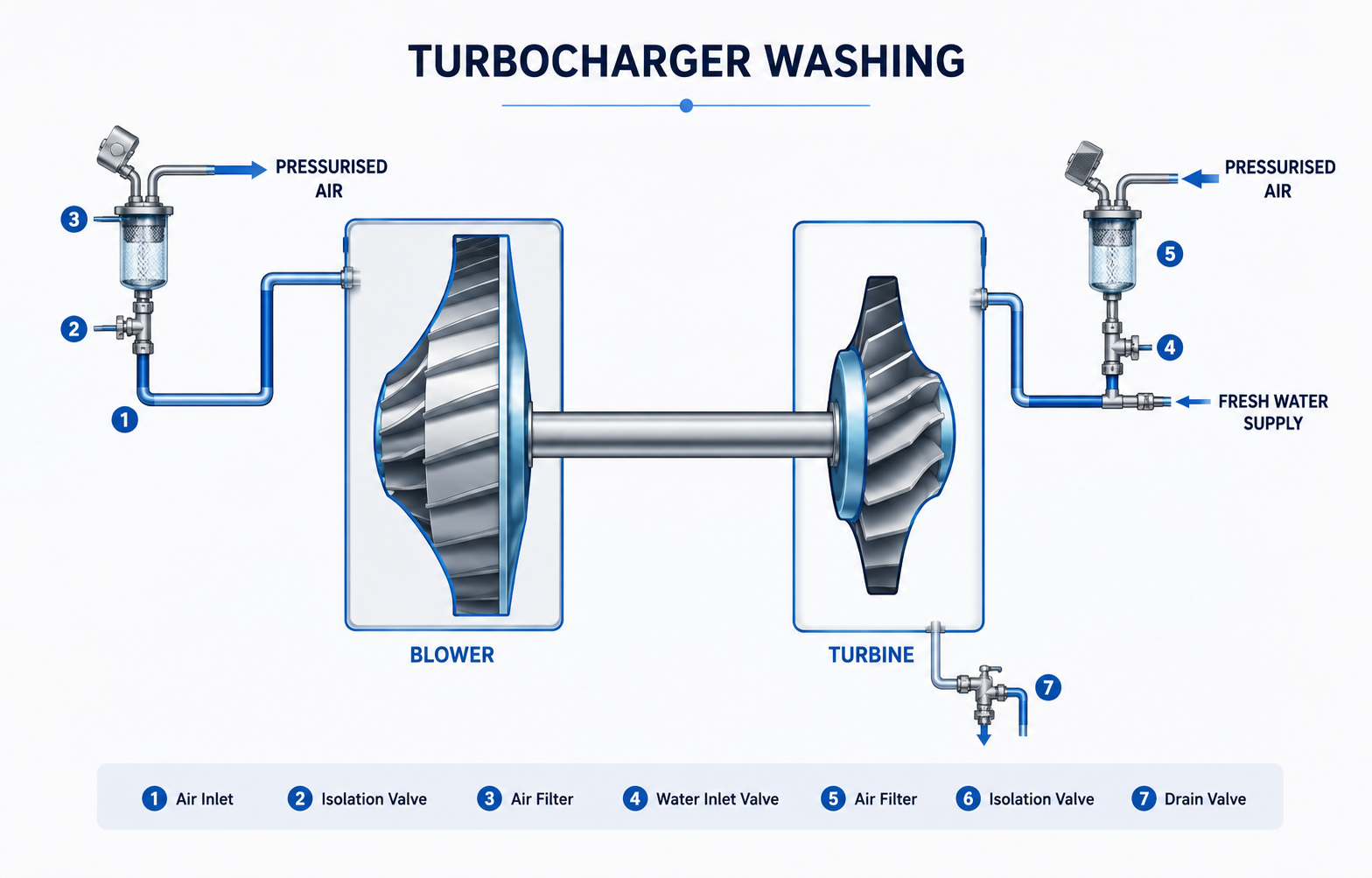
Open the washing valve to allow water to enter the compressor inlet rapidly.The high-speed compressor wheel atomizes the water into fine droplets.
Step 4 – Carbon Removal
The water droplets strike dirt, oil residue, and compressor deposits at high velocity.
This cleaning mechanism is known as Impingement Cleaning, where water physically removes accumulated contaminants from the compressor blades.
Advantages of Compressor Side Washing :
- Restores compressor efficiency
- Improves scavenging air pressure
- Enhances engine combustion
- Reduces compressor fouling
- Improves turbocharger response
- Increases fuel efficiency
2. Turbine Side Wet Washing
Turbine side wet washing was previously a common maintenance practice. However, many modern turbocharger manufacturers no longer recommend this method because uneven carbon removal may create rotor imbalance and accelerate bearing wear.
Operating Procedure
The engine load is gradually reduced to the manufacturer’s recommended RPM.
After stabilization, fresh water is introduced into the turbine casing through a washing connection.
Initially, the injected water evaporates because of the high turbine temperature.
As the turbine cools, carbon deposits soften and gradually dissolve.
Unlike compressor washing, turbine cleaning mainly occurs through the Dilution Process, where water loosens and removes carbon from turbine blades.
The washing process generally continues for approximately 20 minutes, after which the engine remains at steady RPM to dry the turbine before increasing load.
3. Turbine Side Dry Washing (Grit Washing)
Dry washing, commonly known as Grit Washing, remains one of the most effective methods for removing heavy carbon deposits from the turbine side.
Instead of water, specially graded cleaning media is injected into the turbine.
What Material is Used?
Manufacturers commonly recommend:
- Crushed walnut shells
- Organic cleaning grit
Typical particle sizes include:
- 1.5–2.0 mm
- 2.2–2.8 mm
- The correct grit size and quantity must always follow the turbocharger manufacturer’s recommendations.
Dry Grit Washing Procedure
Step 1
Inform the bridge to increase engine RPM to the required operating speed.
Step 2
Drain the starting air line to eliminate moisture.
Step 3
Close Valves 1 and 2.
Step 4
Fill the chamber with the specified quantity of cleaning grit.
Step 5
Close Valve 3.
Step 6
Open Valve 2 to pressurize the chamber.
Step 7
Gradually open Valve 1.
The cleaning grit is carried by compressed air into the turbine, where it removes carbon deposits without damaging the blades.
A whistling sound indicates that all grit has passed through the system.
Best Practices for Turbocharger Washing
- Follow the manufacturer’s maintenance manual.
- Use clean fresh water for wet washing.
- Perform washing at the recommended engine load.
- Inspect drain lines before washing.
- Monitor turbocharger performance after cleaning.
- Record maintenance in the engine logbook.
- Inspect rotor condition during scheduled overhauls.
- Replace worn turbocharger components promptly.
Common Signs Your Turbocharger Needs Cleaning
Watch for these symptoms:
- High exhaust gas temperature
- Reduced scavenging air pressure
- Increased fuel consumption
- Black exhaust smoke
- Slow engine acceleration
- Turbocharger surging
- Excessive vibration
- Reduced engine power
Timely cleaning helps prevent these issues from developing into costly repairs.
Supported Brands:
We supply spares for major turbocharger manufacturers including:
How SINDHU MARINE Ensures Reliable Turbocharger Support
- Large stock availability
- Genuine & OEM spares
- Competitive prices
- Fast global delivery
- Expert technical support
- ISO-certified supply standards
Whether you need a single component or full overhaul kit, our team ensures quick response and accurate supply to keep your vessel operational.
Focus Keywords
- Turbocharger Washing
- Marine Turbocharger Washing
- Turbocharger Cleaning
- Compressor Side Wet Washing
- Turbine Side Wet Washing
- Dry Grit Washing
- Marine Turbocharger Maintenance
- Turbocharger Spare Parts
- Marine Engine Turbocharger
- Turbocharger Overhaul
Conclusion
Turbochargers are at the heart of marine engine performance, improving power, fuel efficiency, and overall engine health. Choosing the right spare parts and maintaining them with precision can make a significant difference in reducing downtime and operational costs.