
Fuel Pump Timing (Lead) Adjustment in Marine Two-Stroke Engines
Correct fuel pump timing — commonly referred to as fuel pump lead — is essential for efficient combustion, even cylinder loading, and reliable performance in a marine two-stroke engine. If the timing drifts from the manufacturer’s specification, the engine can suffer from poor combustion, uneven cylinder temperatures, increased fuel consumption, and higher exhaust emissions. This guide walks through the step-by-step procedure for checking and adjusting fuel pump lead, along with the precautions engineers should take before, during, and after the job.
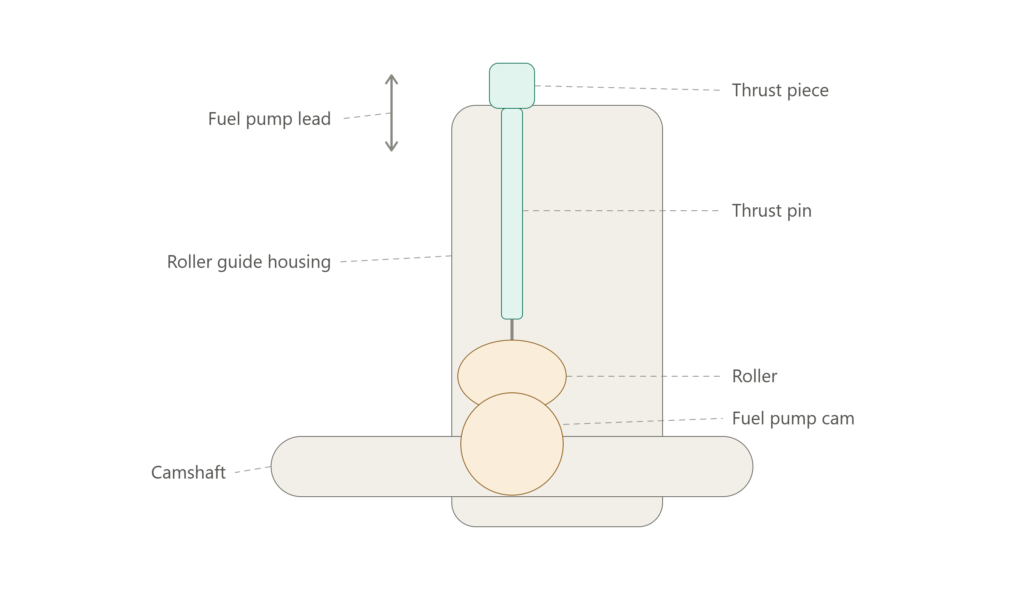
In a marine two-stroke engine, each fuel pump is driven by a cam on the camshaft, acting through a roller and a thrust piece. “Fuel pump lead” is the point, relative to piston position, at which the fuel pump begins effective delivery to the injector. It is set mechanically by the position of the thrust piece above the roller guide housing, which in turn is controlled by shims fitted beneath the thrust piece.
If the lead is advanced too far, combustion starts too early, causing excessive cylinder pressure and thermal loading. If it is retarded too far, combustion is delayed, reducing efficiency and increasing exhaust temperature. Because all units must fire in balance, even a single cylinder with incorrect timing can throw off the whole engine’s thermal and mechanical balance
Before You Begin: Isolate the Fuel System
Before adjusting the lead on any unit, isolate the fuel oil system for that pump by closing the inlet and return valves. This prevents fuel from being delivered while the pump is being worked on and is a basic safety precaution that should never be skipped.
Step-by-Step Procedure
- Isolate the fuel system. Close the fuel oil inlet and return valves for the unit before starting any work on the fuel pump.
2. Bring the roller onto the base circle of the cam. Turn the engine (using the turning gear) until the roller is resting on the base circle of the fuel pump cam — this is the reference position for measuring lead.
3.Measure the fuel pump lead. Using a depth gauge, measure the distance between the upper edge of the roller guide housing and the top of the thrust piece.
4. Compare against the manufacturer’s specification. Check the measured value against the prescribed value in the engine manufacturer’s manual to determine whether — and how much — adjustment is needed.
5. Remove the thrust piece. If adjustment is required, withdraw the thrust piece using the special extraction tool designed for this purpose.
6.Adjust the shims. Add shims of the required thickness to advance the timing, or remove shims to retard it, based on the difference between the measured and specified lead.
7.Refit the thrust piece and re-measure. Use a mallet to seat the thrust piece back into the slot, then repeat the depth-gauge measurement to confirm the lead now matches the specified value.
8.Run the engine and verify combustion. Once all adjusted units are reassembled, run the engine at full load and check the combustion pressure on each unit to confirm even performance across all cylinders.
Safety Precautions
- Always isolate the fuel oil inlet and return valves before starting work on a fuel pump.
- Confirm the engine is properly secured on turning gear (or otherwise immobilized per company procedure) before turning it to position the roller.
- Use only the manufacturer’s specified extraction tool to remove the thrust piece — improvised methods can damage the roller guide housing or thrust pin.
- Always re-measure the lead after refitting the thrust piece, before returning the unit to service.
- Never run the engine at full load to verify combustion pressure until all disturbed units have been reassembled and rechecked.
- Record all as-found and as-left readings in the engine log for trend monitoring and future reference.
Why Accurate Fuel Pump Timing Matters for Engine Health
Consistent fuel pump lead across all units keeps combustion pressures and exhaust temperatures balanced, which reduces thermal stress on pistons, liners, and exhaust valves. Engines with correctly timed fuel pumps typically show more even cylinder exhaust temperatures, lower fuel consumption, and reduced smoke — all of which point back to combustion efficiency. Timing checks should be carried out at the intervals specified in the maker’s maintenance schedule, and whenever a unit is opened up for overhaul or a fuel pump component is replaced.
Sindhu Marine – Fuel Injection & Engine Spare Parts
At Sindhu Marine, we supply genuine and OEM spare parts for main engine fuel injection systems, supporting shipowners, ship managers, and marine engineering companies worldwide.
Our supply scope includes:
- Fuel Pumps and Injectors
- Roller Guide Housings and Rollers
- Thrust Pieces, Thrust Pins and Shim Sets
- Fuel Pump Camshaft Components
- Cylinder Liners and Piston Components
- Turbocharger and Governor Spares
How Sindhu Marine Ensures Reliable Support
- Large stock availability for urgent requirements
- Genuine & OEM spares only
- Competitive prices
- Fast global delivery
- Expert technical support from IMC- and AMI-certified engineers
- ISO-certified supply standards
Conclusion
Fuel pump timing directly affects combustion efficiency, cylinder balance, and overall engine reliability in a marine two-stroke engine. A careful, methodical approach — isolating the fuel system, measuring accurately, adjusting shims precisely, and re-checking before running the engine — keeps the job safe and the result reliable.
For genuine and OEM fuel pump and injection system spares, contact Sindhu Marine, or reach us directly at info@sindhumarine.com / +971 565530207.